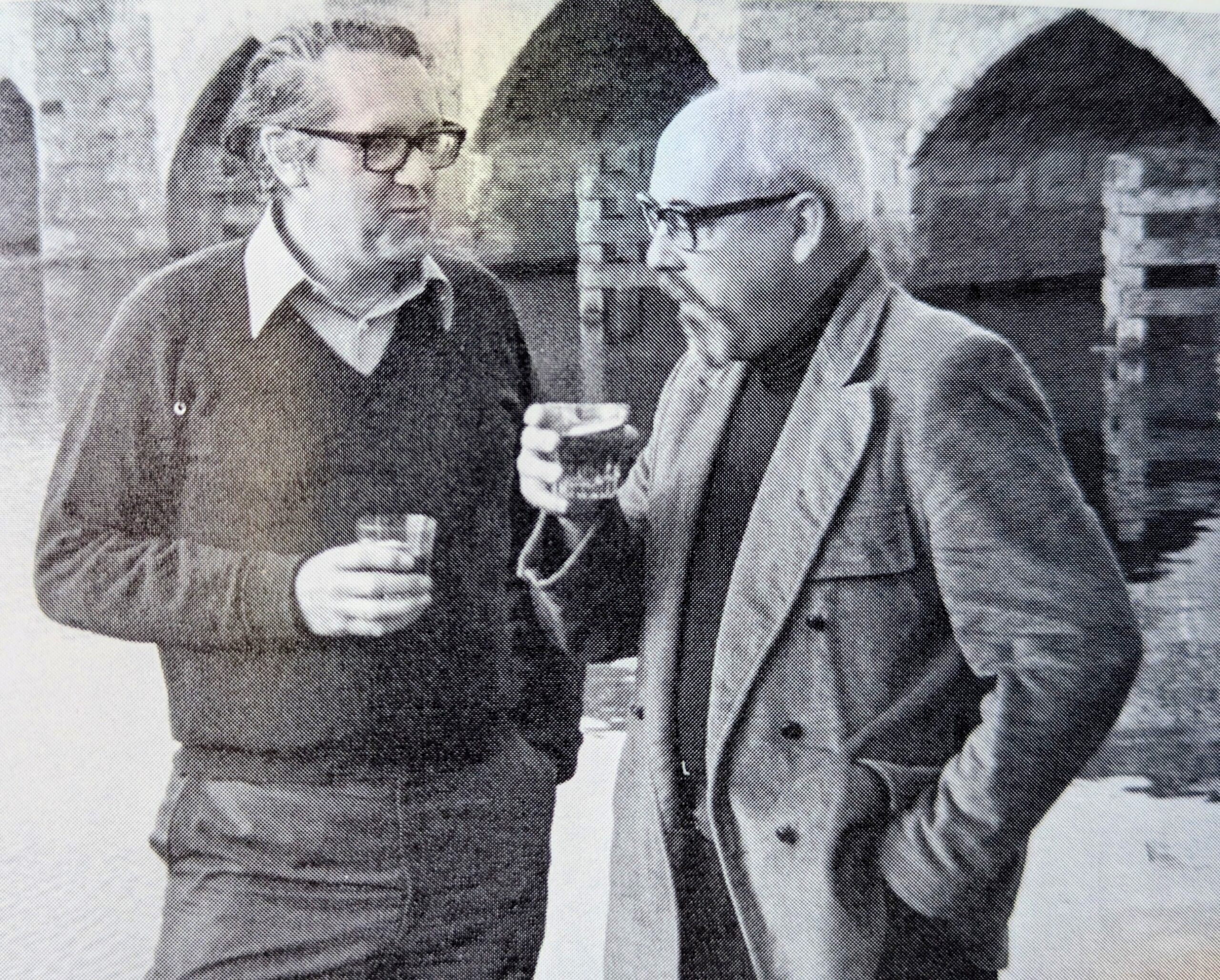
Good old Harry! Life was somehow more fun when Harry was around, growling about the state of the world, laughing about the state of SF!
For some while, Harry had been doing illustrations for comics. Then he wrote his first novel, Deathworld, and sent it to John W.Campbell, celebrated editor of Astounding – the leading SF magazine. Campbell accepted and published Harry’s novel.
Harry took the payment, bought an old travel waggon with it, and drove down to Mexico. He liked Mexico and all the run-down places in the world.
So he and Joan moved to England. They took rooms with some extravert exiles of Muslim faith, just in time for the London World SF Convention. That was where we met. We found we both had the same kind of sense of humour, both were displaced, living on intermittent financial supplies; both enjoyed conversation aided by drink, together with drinks aided by conversation. We got to know Kingsley Amis by such methods.
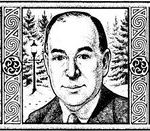
Harry and I were elected co-Presidents of the Birmingham SF Group (that great durable group). We decided that the tone of much SF could be improved by criticism and study. With the assistance of Tom Boardman, the publisher, we put together and launched SF Horizons. Only two issues, unfortunately, ever emerged into daylight. We had to earn a living. We were proud that C.S.Lewis contributed to our second issue.
Harry and I were invited to Trieste, to a new annual film festival. This was held up in the hills of San Giusto. After a year or two, we became judges. The choice of films was eclectic; we watched, for instance, Soviet crime novels, here the villains were American. And we saw Kubrick’s 2001 there up in the hills.
I became friendly with a Hungarian and his pretty wife. They drove us to a remote mountainside, to a house where lived several elegant ladies in old-fashioned garments. They were who was left of Austro-Hungary, the old Dual Monarchy which fell apart at the end of World War One.
Trieste had another frontier, that with Jugoslavia. This division was signified by a rope across the road. Melons and other fruit and vegetables were being sold on either side of the rope; the Jug melons were always the cheaper. Harry and Joan decided to take me for a ride in the Jug hills. I loved the place immediately. We stopped somewhere by the side of the road, where a country woman killed and cooked a chicken for us. Waiting for the meal, we sat and drank Jug red wine while eating delicious plump black olives. The sun shone. We were back in a poor country. I was reminded of Burma and Harry of his father, who had been a moonlighter.
There and then, I decided to see what we affectionately called ‘Jugland’. I persuaded Faber, my publishers, to commission me to write a book on Jugland, and set of in my secondhand Land Rover one morning in March. Harry had a wife and children, and had just moved to Denmark, where he lived quite close to the house of Karen Blixen, another splendid writer.
Harry and I talked things over. He and Joan were planning to holiday in Jugland. We agreed to meet in Makarska, a village on the Adriatic coast, on a certain date in May, at 12 noon. [That was several months ahead.]
Off I went on my travels, with a Scottish girl friend. We drove into the interior, but made sure we were on the coast in May. Makarska was relatively small, relatively smelly. We struck camp in a nearby holiday field before heading for the car park in town, overlooking the Aegean. A few minutes before noon, Harry’s Volkswagen pulled in beside us.
You must imagine how extraordinary that seemed. No long distance phones in those days! No email. Only determination.
Harry and I went for a swim in the river. The girls would not join us. How wise they were! We soon discovered that this river was the village sewer outlet. We dried off and healed ourselves with Slivovitz.
The Harrisons brought us several Dansk goodies such as torskerone, and thick cream, and a chubby paperback which its British publishers called “The most unrelenting study of poverty ever made”. A wonderful thunderous read! To this day, I keep this book with the row of other books in my downstairs lavatory.
Its title: La Vida by Oscar Lewis. I live in Oxford where most people don’t know what real poverty is. Well, it’s here, in this account Harry gave me, half a century ago.
Old Harry was half-Irish, and he eventually moved to Ireland. Joan died, Harry returned to the United States. The couple had produced a son, Toddy, and a daughter, Moira. Moira was a dear girl, and looked after her father when his health was failing.
The well-connected people who decide which writers are suitable to be talked about or written about, on the whole, draw the line against anyone who writes too many books, especially on various subjects, or else is regarded as too poor, or unremittingly too independent… to them one can only say that we too are literate, deriving pleasure from writing, and joy certainly from our friendships. That we are excluded makes friendshjp all the more tasty.