In 1955, Charles was a new member of the distinguished directors directing Faber and Faber. Anyone who had contact with Charles was fortunate indeed. He was a man of great good humour and knowledge, with a brave fondness for both jocularity and drink. One of the first proofs of his wisdom was his rescue of a manuscript by William Golding from the Faber slushpile. This, with Charles’ wise editing, became The Lord of the Flies, a boys’ story and an immense success. Golding never looked back, and became Charles’ great friend.
My good fortune was that I never, as a newcomer to the field of writing, had to submit a manuscript to a publisher. It was Faber, and particularly Charles, who wrote to me asking if I would like to make a novel out of my literary column, “The Brightfount Diaries”, which ran in the pages of the weekly Bookseller.
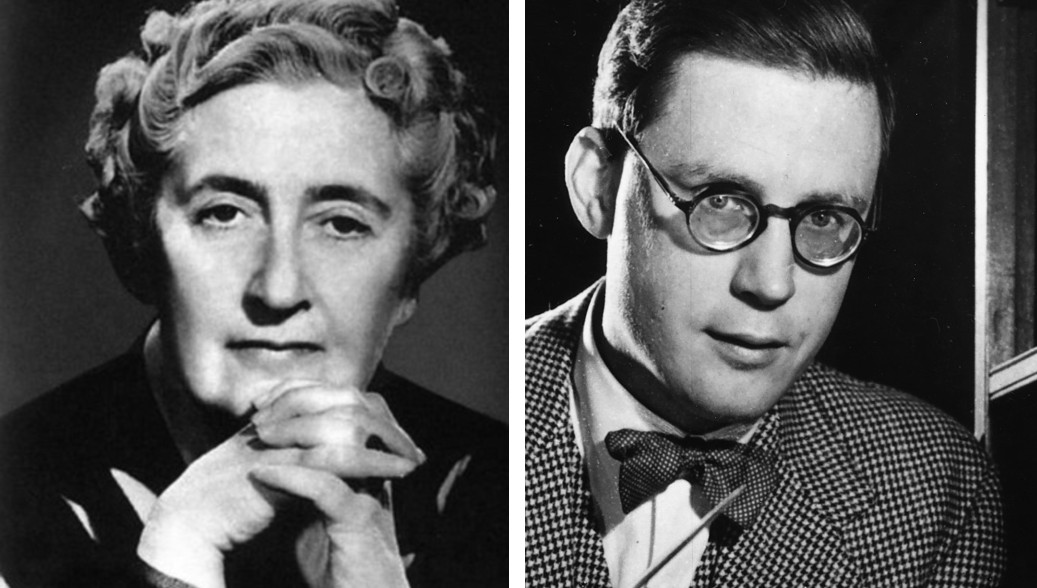
Charles and I saw quite a lot of each other; for many weekends he came down to stay in the hallowed All Souls College. Quite frequently, Charles would invite me to All Souls for lunch. On one memorable occasion he and I lunched with Agatha Christie and her husband. Agatha Christie was then, and remains, amazingly popular.
At one point, late in the meal and the wine, Charles asked Agatha how it was she so cleverly concealed the real villain of the crime in her books.
She explained with a smile that she paused when writing the penultimate chapter of the novel to ask herself, ‘who was the least likely person to have committed the murder?’.
When she had decided, it was simply a matter of changing – let’s say – a relationship (of an uncle becoming a nephew, say) and altering a few train timetables.
We all laughed. The secrets of the trade….. But Agatha had something more than that: her readability.
Not that I ever read one of her novels.
Charles and I found we had two vital points in common, Both of us had served fighting the Japanese in Burma, although Charles had the worst of it, fighting in the Arakan, and was wounded in the leg; his wounded left leg gave him problems throughout life. The other thing we had in common, just as unusual, although far less painful than warfare, was that both of us as boys had subscribed to Modern Boy.
Modern Boy was published by Amalgamated Press, and ran until the first shots of World War II were fired. An excellent magazine.
In those Modern pages we read of the adventures of Captain Justice! Captain Justice and his team lived on the floating Platform A in the mid-Atlantic, where cigar smoking Justice would set about solving all the many crises that the USA and Britain were unable to solve between them. (This included invasions from the Seaweed Men emerging from the Sargasso sea. Not only did Captain Justice appear in Modern Boy, later on, the stories could be bought in paperback form for 4d.
As a small boy, I would go to Websters bookshop in East Dereham and root about behind the door, hoping to find another Captain Justice story.
Webster’s was an excellent bookshop. It ran a lending library, to which my mother belonged. The library books came in cardboard covers, to protect their virginity; on the cover was a printed slogan, It said, “A home without books is like a house without windows.”
Mother was so impressed by this homely wisdom that she read it aloud to me every week. And just look where it has got me!
Captain Justice was invented by an American who came to England as a boy; his name was Robert Murray Graydon, writing under the name of Murray Roberts.
Charles rose to become a distinguished and vital force in Faber’s. Sadly, he had to retire in 1980, because of his ill health. He was born in 1921. His service in Burma in the Enniskillen Fusileers had done him little good.
Charles died on 9th May 1995. A great sorrow. Many were the writers and friends who gathered to mourn Charles’ departure but more particularly to celebrate the memory of this learned, genial, and various man.
And here I must mention another author whose work Charles and I had read intermittently as boys. That’s Charles Hamilton. Although Hamilton’s name is little known, he was one of the most prolific writers ever to pick up a pen. Back in a date which could have been 1930, my parents were buying a house called The Beeches in Norwich Road, East Dereham. The sellers were the Leeds. My mother took me to say good-bye to Mrs Leeds, with whom we were on friendly terms. The Leeds’ son, growing up, gave me a little run of paperback books. I read them all and so became a servitor of the aforesaid Hamilton.
Hamilton’s stories about the public school Greyfriars, starring Harold Wharton and Billy Bunter of the Remove. Prolific Hamilton invented other schools which I preferred to the Greyfriars stories; in particular the stories of St. Jim’s, with Tom Merry and Co, and sometimes other stories of a school called Rookwood.
It seems almost impossible to record all of Hamilton’s writings; about thirty of Hamilton’s pen names have been traced. Nowadays, despite a later TV appearance of Billy Bunter, Charles Hamilton is not a celebrated name. In his day – and in our day – he must have delighted many a juvenile reader, to set them on a course of reading throughout life.
A reference book to have, to check up upon both Tom Merry and Captain Justice, is The Men Behind Boy’s Fiction, written by W.O.G. Lofts and D.J. Adley. Published by Howard Baker in 1970.
I once suggested to Charles that we should write a critique of Hamilton’s and Graydon’s work, but alas, we never found the time. Or, by that date, possibly the inclination.