
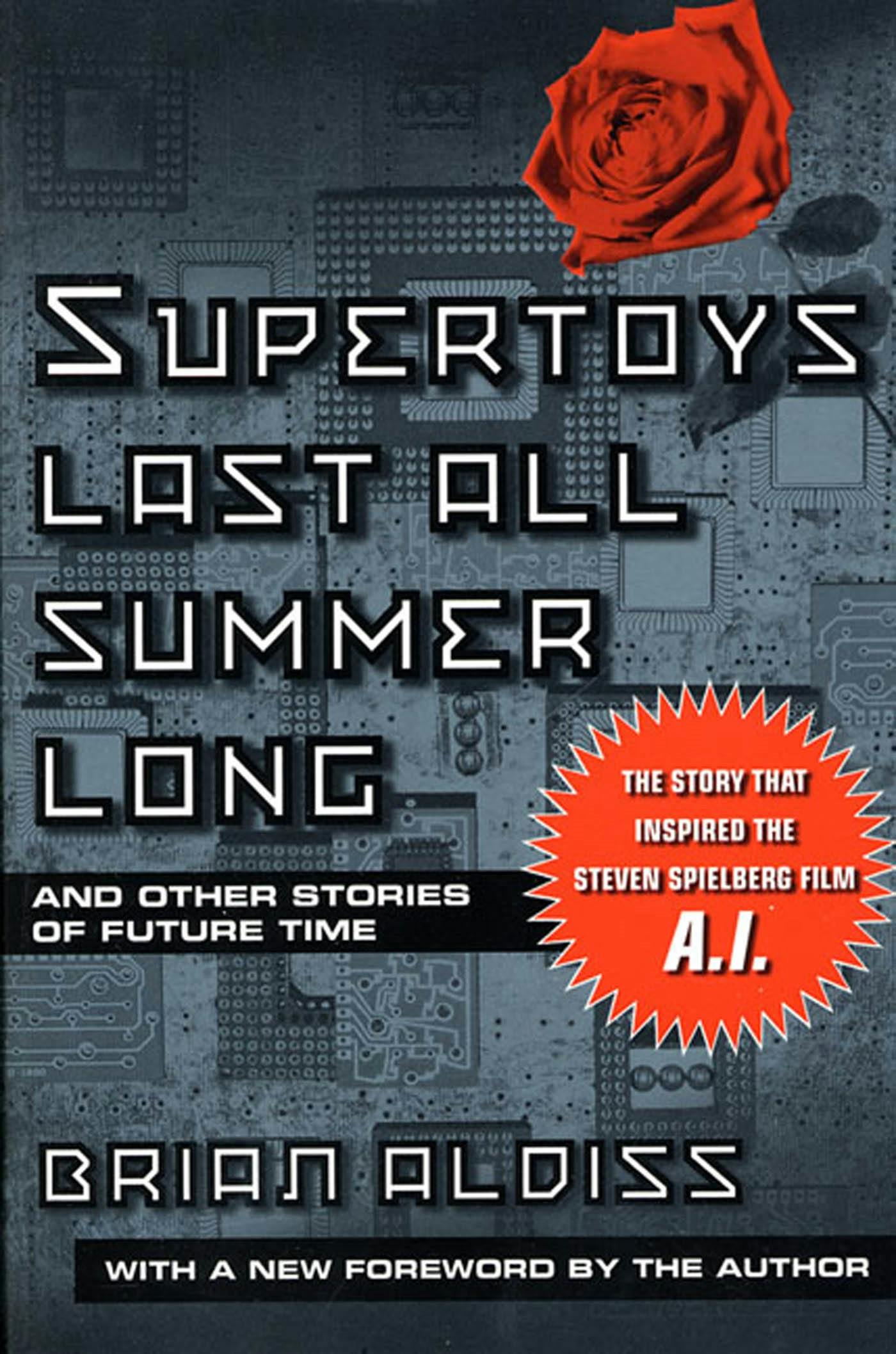
Few short stories in science fiction have cast a longer and more curious shadow than Brian Aldiss’s Supertoys Last All Summer Long. First published in 1969, the story’s quiet, melancholic exploration of artificial consciousness would eventually become the seed of one of cinema’s most legendary unrealised projects: Stanley Kubrick’s A.I. Artificial Intelligence.
A lecture by Kubrick scholar Filippo Ulivieri traces the extraordinary, often turbulent evolution of Kubrick’s engagement with Aldiss’s tale — a development process spanning two decades, multiple writers, and an ever-expanding conceptual scope. What emerges is not just a history of an unmade film, but a revealing portrait of Kubrick’s creative method in his later years.

From Short Story to Cinematic Obsession
Kubrick first approached Aldiss in 1976, searching for a new project after Barry Lyndon. Unlike Kubrick’s usual practice of adapting fully formed novels, A.I. would follow the model of 2001: A Space Odyssey: expanding a short story into a richly layered narrative universe.
Kubrick acquired the rights to Supertoys in 1982. His early vision was strikingly clear in tone if not in plot mechanics. The film, he told Aldiss, must be emotionally moving and structured as a modern fairytale, drawing explicitly from Pinocchio. The robot child David would echo Collodi’s puppet: a manufactured being yearning to become “real.”
Yet Aldiss’s attempts to build a larger storyline — including an espionage-driven treatment involving Russian intelligence — drifted away from what Kubrick considered the core: a robot boy longing for maternal love. Despite moments of conceptual alignment, the collaboration stalled.
A Cascade of Writers and Ideas
Kubrick’s subsequent search for narrative breakthroughs brought in an eclectic roster of writers:
- Bob Shaw (1989) – A brief, reportedly difficult collaboration.
- Brian Aldiss (1990) – A revised treatment introducing Monica’s biological son and a drowned New York setting.
- Ian Watson (1990–91) – The most prolific contributor.
Watson’s work proved transformative in scale. In less than a year, he generated an immense body of material — mythic, philosophical, speculative. His treatments fused artificial intelligence with Arthurian legend, Christian allegory, environmental catastrophe, and far-future evolution. Concepts such as Gigolo Joe, the Blue Fairy, and the two-thousand-year leap into the future took shape here.
And yet, Ulivieri notes, Kubrick rejected the overwhelming majority of Watson’s ideas. What survived were fragments — evocative, resonant, but selective: a sexualised Joe character, surrogate maternal figures, and the haunting coda of humanity’s extinction followed by Monica’s one-day resurrection.
The Reactive Genius
Ulivieri characterises Kubrick not simply as a creative genius, but as a reactive genius — an artist who thrived on stimuli, variations, and permutations generated by collaborators. Writers were encouraged to explore freely, often with minimal direction.
Ian Watson described the challenge succinctly: Kubrick “knew that he wanted something; he did not know what it was.” Sara Maitland, hired later to restore coherence, similarly observed that her role often involved guessing Kubrick’s internal imagery and translating it into words.
This method had previously yielded triumphs. With 2001, story invention and production realities evolved simultaneously, forcing decisions under practical pressure. But with A.I., Kubrick remained locked in the exploratory phase. The process became, in Ulivieri’s telling, literally endless.
Perfectionism Without Constraint
Several factors compounded the project’s inertia:
- Technical hurdles – Convincing android performances and a photorealistic drowned world were beyond the era’s capabilities.
- Narrative sprawl – Expanding thematic ambitions risked unwieldiness.
- Institutional freedom – Under Warner Bros., Kubrick faced no deadlines, no pressure to commit.
Watson’s recollection of the studio’s attitude is tellingly wry: they simply hoped for “another movie out of Stanley before he pops his clogs.” Without external constraint, Kubrick’s perfectionism — once a driving force — may have become paralysing.
Aldiss’s Enduring Core
Despite the decades of revisions, Ulivieri highlights a striking continuity. The emotional DNA of Aldiss’s original story — the loneliness of a robot child, the ache for maternal recognition — persisted through every iteration.
Even as Watson’s mythic expansions and Kubrick’s structural tinkering reshaped the narrative, the essential question remained Aldissian:
What does love mean to a being designed to feel it?
An Unfinished Dream
Kubrick ultimately set A.I. aside in 1996 to focus on Eyes Wide Shut. After his death, Steven Spielberg would bring his own interpretation to the screen — a film at once indebted to and divergent from Kubrick’s evolving vision.
For science fiction readers, Kubrick’s unmade A.I. occupies a fascinating liminal space: part Aldiss, part Watson, part Kubrickian thought experiment. It stands as a reminder that some of the genre’s most influential works are not films or novels, but creative dialogues stretching across decades.
And at the centre of that dialogue remains Aldiss’s slender, devastating vignette — a vintage AI classic that proved inexhaustible.